
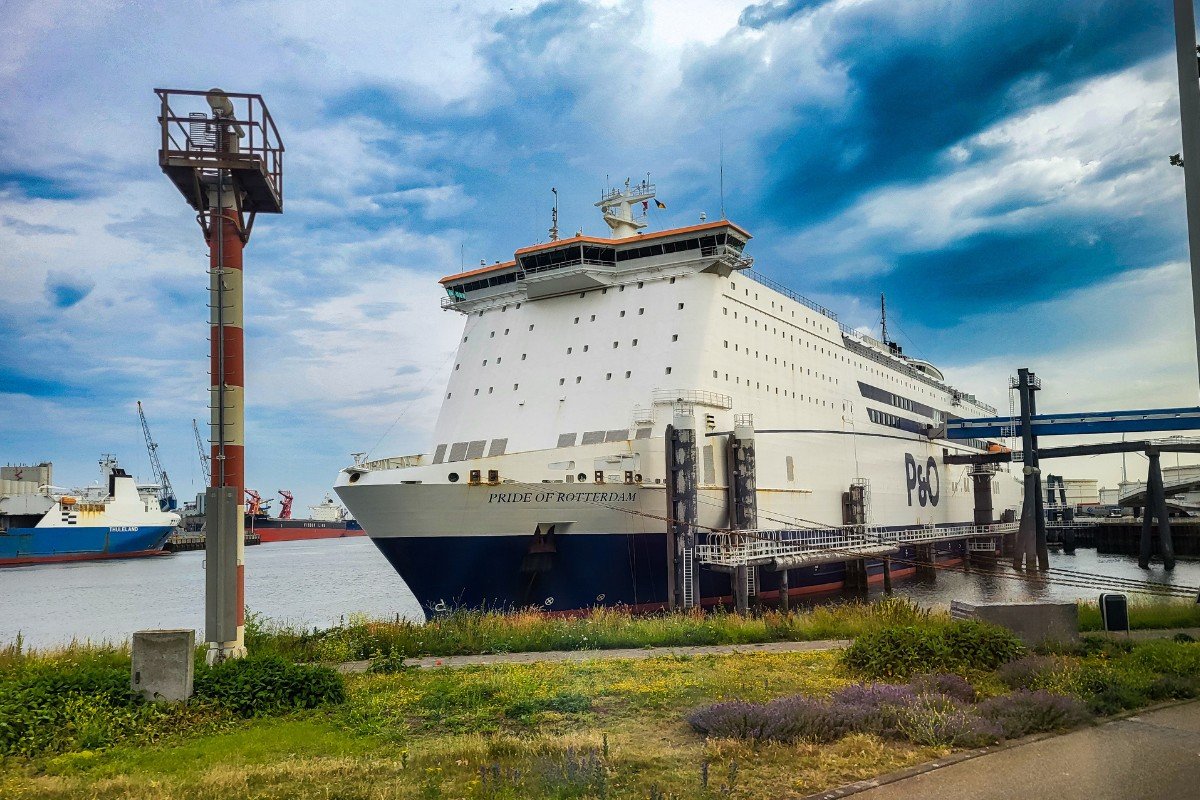
There is now a lot of awareness about the impact of travel on the environment. For example, we all know that flying is more harmful to the climate than the train. But why are ferries missing that much in those calculations, and what exactly is the impact of a ferry compared to flying, coach, cruise, or train? We researched many official scientific sources and came up with the following conclusion:
The ferry is a much more conscious choice than flights.
If we compare the ferry to flying or cruises, the ferry is an environmentally friendly choice. This is especially true when comparing the ferry emission to a short flight. Traveling as a foot passenger by ferry is the best option for minimizing your carbon footprint. However: The international train has the least negative impact on carbon footprint. The carbon footprint for a foot passenger on a ferry is only 19 grams per km. That is considerably less than the 244 grams per km for a short flight.
Better to leave the car in the parking lot
Even if you make the journey by car on board, the ferry is a significantly more conscious choice than flying. Especially if you are in the car with several people. Are you traveling with 4 people in a car on board a ferry? This results in 44 grams of Carbon dioxide emissions per kilometer (versus the 244 grams per kilometer for a flight).
It goes without saying that carbon dioxide emissions increase when you board a car instead of without. If you really want to travel consciously, it is therefore best to leave the car at the port or - better still - travel to the port by public transport. This option can also save you a lot of money.
Calculate your own carbon footprint for your trip
You can fairly easily estimate the carbon dioxide emissions of your own trip. You can multiply the number of kilometers by the emissions in grams per kilometer. If you do that for both the plane and the ferry (possibly in combination with the car), you get a fairly good idea of what the most environmentally friendly trip is.
In the example below we have multiplied the Carbon Dioxide emissions per kilometer by the distances you travel on a trip from Amsterdam to Liverpool.
Carbon footprint plane versus ferry: Amsterdam-Liverpool
| Plane | Distance | Carbon dioxide kg |
|---|---|---|
| 🚌 Amsterdam→ Schiphol | 20 km | 0,54 |
| ✈️ Schiphol→ J. Lennon | 524 km | 127,9 |
| 🚌 J. Lennon→ Liverpool | 15 km | 0,4 |
| Total | | 128,8 |
| Ferry | Distance | Carbon dioxide kg |
|---|---|---|
| 🚗Amsterdam → Rotterdam | 80 km | 3,5 |
| ⛴️ +🚗 Rotterdam→ Hull | 365 km | 16,8 |
| 🚗 Hull→ Liverpool | 210 km | 9,2 |
| Total | | 29,6 |
How is the carbon footprint determined?
To determine how polluting a means of transport is - the carbon footprint - the carbon dioxide emissions per kilometer are usually taken into account. Carbon dioxide, or CO2, is created by the combustion of a carbon atom. Every carbon atom burned will produce one CO2 molecule. An oxygen atom weighs 1⅓ times as much as a carbon atom, so a carbon dioxide molecule weighs 2 x 1⅓ + 1 = 3⅔ times as much as a carbon atom.((How can carbon emissions be weighed?, Niwa.co.nz))
The extent to which carbon dioxide is produced depends on the amount of energy required and the source of this energy. For example, a TGV that runs on French nuclear energy has much fewer emissions than a train that runs on electricity produced in a coal-fired power station.
What fuel do ferries run on?
What does a ferry actually sail on? Most boats sail on gas oil (diesel), but there are also more and more ships that sail on:
- LNG/LPG - Less carbon dioxide emissions (± 25%), nitrogen oxides (NOx), and sulfur oxides (SOx).((Restwarmtegenerator "single fuel" LNG ferries business case, Dutch, Berger Maritiem))((The climate implications of using LNG as a marine fuel, theicct.org))
- Electricity - environmental benefit depending on how the electricity is generated
- Hydrogen - environmental benefit depending on how the hydrogen is produced
Although the ferries that run on LNG are often called green, they are not 100% green. It is however a better alternative to the ferries that run on gas oil/diesel and therefore 'greener'.
The carbon footprint of ferries
In ferries, fuel consumption is highly dependent on current, weather conditions, and speed. For example, consumption can increase by more than two-thirds in a major storm.((Vragen aan de kapitein van Process Seaways, Dutch, DFDS)) The efficiency of the engine, the hull shape (resistance), and the weight are also important. In short: the emissions differ enormously per ferry.
Shipping companies can usually estimate the emissions of a crossing quite well. After all, they know how much fuel is needed, how many kilometers are sailed, and how many passengers and personnel are on board.
With this data, you can calculate the emissions per passenger. But not every passenger travels the same way. Some people board on foot and others travel in a motorhome. Ferries also carry heavy cargo, which influences the emissions per passenger.
In order to gain insight into the emissions per passenger, the British government has put together a handy industry standard. This is established by looking at the weight of ferry passengers with their luggage, the weight of a car, and the weight of cargo on board the ferry.((2020 Government greenhouse gas conversion factors for company reporting, GOV.uk))
| Carbon footprint by ferry as a | kg carbon dioxide emission pp per km. |
|---|---|
| Foot passenger | 0,01874 |
| Car passenger | 0,12952 |
| Average | 0,11286 |
Ferry emissions are not to be confused with cruise emissions
With a carbon footprint of 250 grams per passenger per kilometer, cruises have a bad name.((What if i told you cruising is worse for the climate than flying, theicct.org)) However, you cannot extend these emissions to the much more efficient ferries that are designed for transport and therefore efficiency instead of luxury and comfort on board.